Guides
AI Data Centers Explained: Your Questions Answered (2026)
What are AI data centers? Energy, water, costs, jobs, and community concerns — the most common questions answered in plain English.
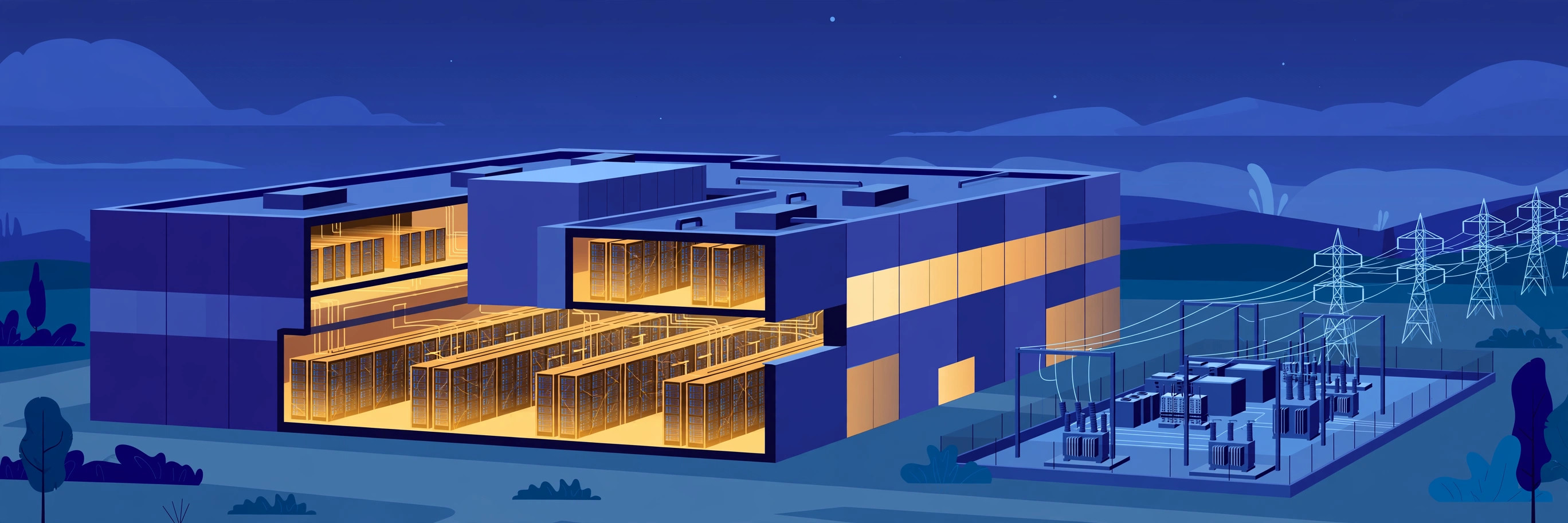
Data centers are the physical buildings where AI lives. Every time you ask ChatGPT a question or generate an image, your request travels to a massive facility full of specialized computers that do the actual work. As AI has exploded, companies are building these facilities at a historic pace — and that building boom has sparked big questions about energy, water, and who benefits. Here are the most common questions, answered plainly.
What is a data center, actually?
Strip away the jargon: a data center is a large, secure building filled with racks of computers, plus the power and cooling systems to keep them running 24/7. You've used them your whole digital life — every email, photo backup, and Netflix stream runs through one. AI data centers are the same idea, but packed with specialized AI chips (mostly GPUs) that are far more powerful — and far thirstier for electricity — than regular servers.
Think of it this way: a traditional data center is a library; an AI data center is a power plant that happens to compute.
Why does AI need so many of them?
Two reasons, both growing:
- Training. Teaching a state-of-the-art AI model requires tens of thousands of chips running for months. Only warehouse-scale facilities can do it.
- Answering you. Every query — "inference" — takes compute. With billions of people using AI daily, the ongoing cost of answering queries now rivals or exceeds training. More users means more data centers, permanently.
That's why this isn't a temporary construction spike. As long as AI usage grows, data center demand grows with it.
How much energy do they really use?
Data centers of all kinds used about 415 terawatt-hours of electricity in 2024 — roughly 1.5% of the world's electricity, about as much as a medium-sized country — and 2026 demand is forecast at 565 TWh, up 26% in a single year. AI servers are now nearly a third of all data-center power and climbing. A single large AI facility can draw as much power as a small city.
For a sense of scale at the personal level: one AI chat query can use several times the electricity of a traditional web search — published estimates range from barely above a search to 10x or more depending on the model. Your individual queries are still trivial in absolute terms, but billions of them add up fast.
The honest uncertainty: nobody knows where the growth curve flattens. It depends on chip efficiency, how fast usage grows, and what powers the new builds.
What about water?
Chips generate enormous heat, and heat has to go somewhere. Many data centers use water-based cooling, and a large facility can consume millions of liters of water per day — a genuine concern in drought-prone regions.
The good news: newer designs use closed-loop and liquid cooling that recycle water instead of evaporating it, cutting consumption dramatically. The bad news: plenty of older facilities still use thirsty designs, and "newest technology" isn't guaranteed at every site. If a data center is proposed near you, the cooling design is one of the most important questions to ask.
Where are they being built — and why there?
Data centers cluster where three things are cheap and available: electricity, land, and water — plus tax incentives. That's why you see them concentrated in places like Northern Virginia (the world's densest data center corridor), Texas, and parts of the Midwest: affordable power, open land, and welcoming local governments.
Increasingly, though, the binding constraint is power, not land. Some regions' grids are struggling to keep up, which is pushing builders toward places with abundant energy — near hydroelectric dams, in windy plains, or wherever they can secure their own power supply.
The mega-projects you've heard about
A few names keep appearing in headlines:
- Colossus — xAI's (Elon Musk's AI company) massive supercomputer facility in Memphis, Tennessee, built to train its Grok models. It's become a case study in both the scale of AI infrastructure and community pushback over power and air quality.
- Stargate — OpenAI's multi-hundred-billion-dollar infrastructure program with partners, planned as a network of enormous AI data centers. If completed as described, it would be among the largest private infrastructure projects in history.
- Hyperscaler buildouts — Microsoft, Amazon, Google, and Meta are each spending tens of billions annually expanding data center capacity, much of it AI-focused.
Take the dollar figures with a grain of salt — announced investment and actual spending often differ — but the direction is unmistakable.
Why are communities pushing back?
The backlash is real and worth understanding, because it's not just NIMBYism. Common concerns:
- Electricity bills. If utilities build new power plants and grid upgrades mainly to serve data centers, residents worry the costs will land on their bills. In some regions, this is already happening.
- Water. In dry areas, a thirsty cooling system competing with farms and households is a legitimate conflict.
- Noise and air. Backup diesel generators and constant industrial hum affect neighbors. The Memphis/Colossus dispute centered partly on generator emissions.
- Jobs vs. promises. Data centers create lots of construction jobs but relatively few permanent ones — sometimes a few dozen for a billion-dollar facility. Communities promised prosperity sometimes feel shortchanged.
None of these are arguments against data centers existing. They're arguments about where, how, and on whose terms — which is exactly the right debate to have.
Can data centers run on clean energy?
Technically, partially — and increasingly. The challenge is that data centers need power 24/7 without interruption, which solar and wind alone can't guarantee. That's why you're seeing:
- Nuclear deals — Microsoft, Amazon, and Google have signed agreements for nuclear power, including restarting mothballed plants. It's the only current source of 24/7 carbon-free power at this scale.
- Massive renewable purchases — the big tech companies are among the world's largest buyers of wind and solar.
- Bringing their own power — some new facilities are designed with dedicated generation so they don't strain the public grid.
For more on the environmental side, see our guide Is AI Bad for the Environment?
Frequently asked questions
Will data centers raise my electricity bill?
Possibly, depending on where you live and how regulators assign grid-upgrade costs. It's an active political fight in several states. If you live near a proposed facility, this is worth following in local news.
How many jobs does a data center create?
Hundreds during construction (temporary), then surprisingly few permanent roles — often a few dozen technicians, security, and operations staff for a very large facility. The bigger employment story is in building them: construction, electrical trades, and cooling specialists are in high demand.
Are data centers bad for the environment?
They're energy- and water-intensive, which is a real impact — but "bad" depends on what powers them and how they're cooled. A nuclear-powered, closed-loop-cooled facility is a very different thing from a coal-powered, evaporative-cooled one. Design and location matter enormously.
Why not just build them all in cold places?
Cool climates help with cooling costs, and some facilities are in Scandinavia for exactly this reason. But you still need massive power transmission, fiber connectivity, and political stability — cold alone isn't enough.
Do I have any say if one is built near me?
Yes — data centers go through local planning and permitting. Public hearings, water-use permits, and grid-connection approvals are all points where community input matters. Showing up works.
The bottom line
Data centers are the physical foundation AI stands on — neither villains nor saviors, just very large, very thirsty buildings doing very intensive math. The important questions aren't whether to build them but how: what powers them, how they cool themselves, and whether the communities hosting them get a fair deal. Those are debates worth having, and now you know enough to join them.