Guides
The AI Robots Already Working in Warehouses (2026)
Digit at Amazon and GXO, Figure at BMW, Optimus at Tesla — where AI humanoids are doing real paid work in 2026, and what that means for everyone else.
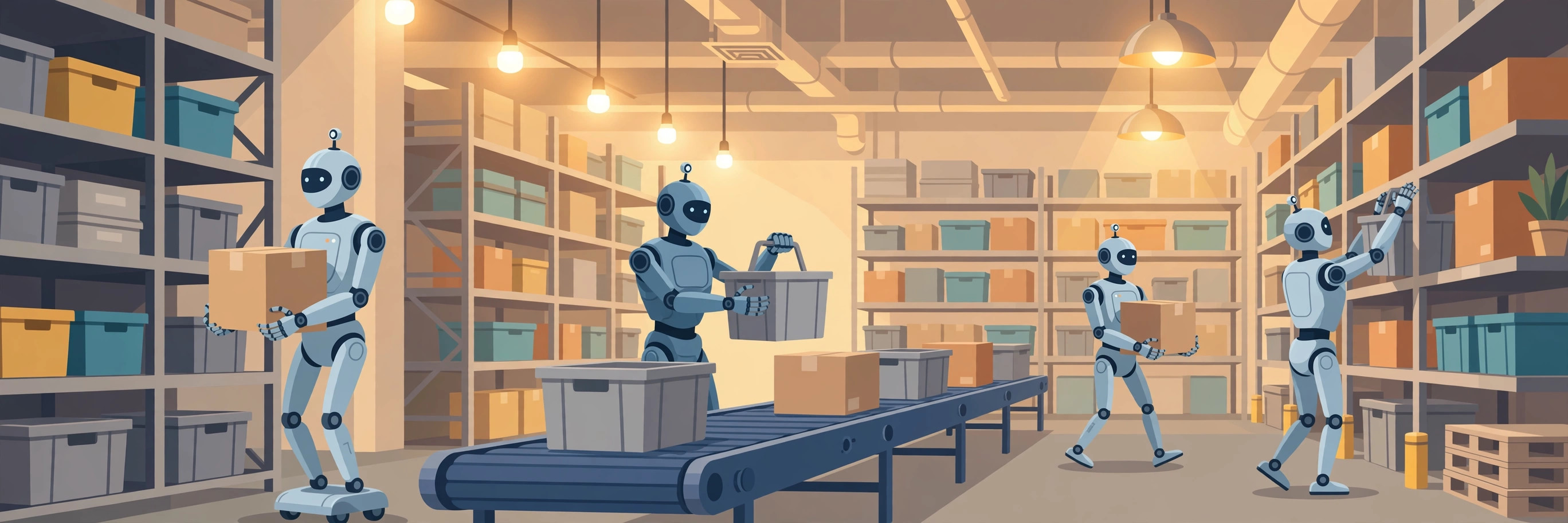
While the world argues about whether humanoid robots belong in the living room, they are already clocking in at work. Warehouses and factories are where robotics earns its keep today — not in demos, but in paid shifts, measured in totes moved and hours logged. Here is what is actually working on warehouse floors in 2026, and what it tells you about how fast the rest is coming.
One pattern is worth naming up front: every real deployment is narrow. No robot does "everything." Each one does a specific, repetitive job — moving totes, inserting sheet metal, sequencing parts — in an environment designed around it. That specialization is exactly why warehouses work for robots years before homes do.
Agility Robotics' Digit: the humanoid already on the payroll
If one robot represents the state of warehouse humanoids, it is Digit, built by Oregon-based Agility Robotics. Digit is purpose-built for logistics: 5 feet 9 inches tall (175 cm), about 65 kg, with 28 degrees of freedom, a 35-pound payload, and roughly an 8-hour battery — enough for a full warehouse shift. It navigates with LiDAR and depth cameras, running on NVIDIA's Jetson AGX Thor compute.
What separates Digit from the demo crowd is that customers pay for it. Agility sells Digit as robotics-as-a-service: companies pay a subscription-style fee and Agility maintains the robots, rather than selling expensive machines outright. The deployments are real:
- GXO Logistics — at GXO's Spanx facility in Georgia, Digit fleets have been doing paid tote-moving work since June 2024 and have moved more than 100,000 totes, under an industry-first multi-year RaaS agreement.
- Amazon — Amazon's Industrial Innovation Fund invested in Agility, and Digit has been tested in Amazon fulfillment operations on tote recycling and material handling. Amazon remains the anchor reference customer.
- Toyota Motor Manufacturing Canada — a year-long pilot with three Digits converted into a commercial agreement covering seven robots in February 2026.
- Mercado Libre and Schaeffler — active deployments at logistics and manufacturing sites.
By May 2026, Agility reported deployment commitments across nine customer facilities and more than 65,000 hours of paid operation. Its RoboFab factory in Salem, Oregon is rated to produce more than 10,000 Digits per year — the first humanoid factory built for real volume. In June 2026, Agility announced a SPAC merger at an implied ~$2.5 billion valuation, aiming to list as AGLT before year-end — which would make it the first US-listed pure-play humanoid company.
The honest read: Digit works because it does one job — moving standardized totes in structured environments. It is not a general helper. But "moves 100,000 totes for paying customers" is the most honest metric in humanoid robotics right now.
Figure AI at BMW: the longest-running factory test
Figure AI's Figure 02 ran one of the most sustained real-world humanoid pilots of any Western company at BMW's Spartanburg, South Carolina plant. Over 11 months, the robots handled sheet-metal insertion on live production lines — loading parts into welding fixtures on standard 10-hour shifts, Monday through Friday. The tally: more than 90,000 components moved, about 1.2 million steps taken (roughly 200 miles of travel inside the plant), supporting production of over 30,000 BMW X3 vehicles.
BMW engineers monitored the robots through the plant's existing digital factory systems, and the machines targeted ergonomically difficult roles — repetitive heavy lifting — rather than displacing workers. On June 25, 2026, BMW announced the next step: the new Figure 03 would begin a logistics sequencing use case in Hall 52, sorting unsorted components into sequencing trolleys so parts arrive at assembly stations in the correct order. Figure 03 adds soft exterior components for safety, wireless charging, speech communication, and hands with tactile sensors and palm cameras.
German supplier Schaeffler has also run Figure 02 pilots in its European plants. The honest read: BMW's deployment is the best evidence that humanoids can work safely beside people on real production lines — but it remains a pilot program, measured in specific tasks, not full shifts of general labor.
Tesla Optimus: internal only, for now
Tesla's Optimus is the most famous humanoid in the world and the least deployed. Tesla uses Optimus Gen 2 units inside its own factories — sorting battery cells, moving totes — but on Tesla's Q4 2025 earnings call, Elon Musk admitted the robots were "not in usage in our factories in a material way." External sales have not begun; current builds number in the hundreds for internal iteration, though supply-chain reports from September 2026 suggest roughly 15,000 units planned through 2026.
Tesla's plan is to lease Optimus units to external companies where they will collect training data, with consumer sales likely in 2027 or later. Musk has floated a long-term $20,000–$30,000 price target at scale. The honest read: Optimus is proven internally but unproven with paying customers — the exact opposite of Digit's trajectory.
The rest of the shift: UBTECH, Apptronik, Boston Dynamics
The warehouse story is bigger than two companies. China's UBTECH runs one of the most aggressive factory rollouts anywhere, with its Walker S humanoid deployed in BYD, Geely, and Foxconn facilities doing parts sorting, quality inspection support, and inter-station material handling — many small pilots, iterated quickly. Apptronik's Apollo is running logistics pilots of its own, with hot-swappable battery packs that let it keep working through a simple swap instead of a charge cycle. And Boston Dynamics' all-electric Atlas remains the most athletic humanoid ever built; the company says it will perform high-precision sequencing work at scale in 2028, with complex assembly tasks planned for 2030.
What the warehouse era tells you
Three lessons from the robots already on the job:
- Revenue is the only demo that matters. Digit moved 100,000 totes for paying customers; Figure's robots supported 30,000 vehicles. Promotional videos are marketing; purchase orders are proof.
- Structure beats smarts. Warehouses work because the environment is controlled — flat floors, standardized bins, predictable routes. Homes are the opposite of controlled, which is why the home humanoid is years behind.
- The path to your home runs through the warehouse. Every hour Digit and Figure 02 log in production is training data that makes the next generation cheaper and more capable. The home robots of 2030 are being trained on warehouse floors in 2026.
The bottom line
The humanoid revolution is not coming — it is already clocking in, wearing a hi-vis vest instead of an apron. If you want to see what AI robots can really do today, skip the chore-folding demos and look at the tote-moving fleets. The warehouse is where robots stopped being promises and started being employees.
FAQ
Are humanoid robots actually working anywhere today?
Yes — in warehouses and factories. Agility Robotics' Digit moves totes for paid logistics customers like GXO, and Figure AI's robots worked live BMW production lines for 11 months. These are narrow, specific jobs — but real paid work, not demos.
How much does a warehouse humanoid robot cost?
Agility sells Digit as a service (robotics-as-a-service) with subscription-style pricing rather than outright sales, which lowers the risk for companies testing automation. Tesla targets $20,000–$30,000 per Optimus at eventual mass-production scale, but that is an aspiration, not a current price.
Will warehouse robots replace human workers?
So far, deployments target ergonomically difficult, repetitive jobs — heavy lifting, tote moving, sheet-metal handling — that are hard to staff. BMW reported no workers displaced in its Figure pilot. The trend is augmentation of hard-to-fill roles rather than wholesale replacement.
When will robots like this work in my home?
The skills transfer, but the environment does not. Warehouses are structured and predictable; homes are cluttered and chaotic. Most analysts expect home-capable humanoids to lag warehouse robots by several years — the warehouse is where the technology is being proven and paid for today.