Comparisons
Midjourney vs DALL-E vs Stable Diffusion in 2026
Midjourney vs DALL-E vs Stable Diffusion in 2026: image quality, ease of use, cost, and commercial rights compared so you can pick the right AI image generator.
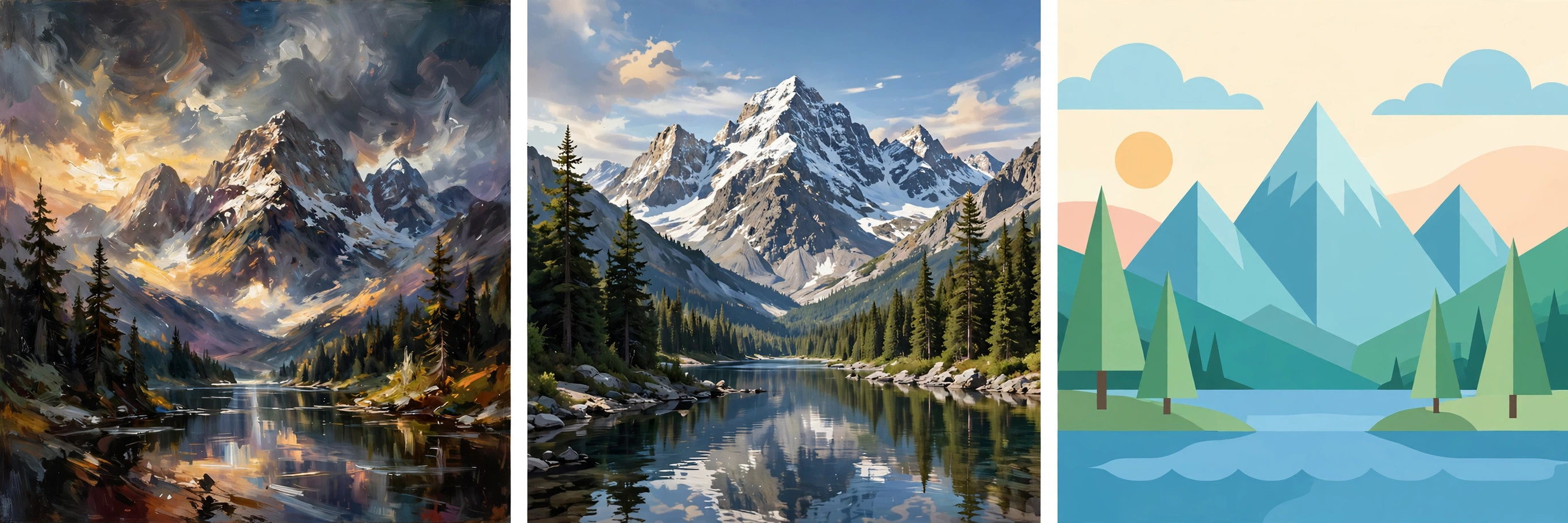
Midjourney, DALL-E, and Stable Diffusion are the three names in almost every conversation about AI image generation, but they are not three versions of the same thing. Midjourney is a subscription service built for beautiful images. DALL-E 3 lives inside ChatGPT and is the easiest to use. Stable Diffusion is open-source software you can run on your own computer for free. Picking the wrong one usually means paying for a subscription you do not need, or spending a weekend setting up software when you just wanted a picture.
This comparison covers what each tool actually does in late 2026, what it costs, and which one fits which kind of user. Prices were checked against vendor pages and current comparisons in November 2026, but plans change, so confirm on the official site before you pay.
At a glance
| Tool | Best for | Starting price | Free tier | Commercial rights |
|---|---|---|---|---|
| Midjourney | Beautiful, artistic images with the least effort | $10/month | None | Yes, on paid plans |
| DALL-E 3 | Easy images inside ChatGPT; great text rendering | $20/month via ChatGPT Plus (or free via Bing) | Yes, via Bing Image Creator | Yes |
| Stable Diffusion | Full control, custom styles, local privacy | Free (self-hosted) | Yes, open source | Yes, under the open license |
Midjourney: the art director
Midjourney's reputation is simple: of the three, it produces the most striking images with the least prompting. Give it a short description and it returns four polished, atmospheric results that usually look like they came from a designer. That is why marketers, concept artists, and content creators keep paying for it.
The current default model is V8.2, standard since July 2026. It renders native 2K images (2048 x 2048), generates roughly four to five times faster than earlier versions, and handles detailed prompts and text inside images better than before. A new Edit model lets you change parts of an image with written instructions, and Draft mode produces quick previews before you spend GPU time on a full render. You use it through the web app at midjourney.com or in Discord.
Midjourney charges for GPU time, not per image. Every plan includes a monthly allowance of Fast GPU hours; once that is used up, Standard and higher plans fall back to Relax mode, a slower unlimited queue. Basic has no Relax mode, so when its 3.3 Fast GPU hours run out, you either buy more time at $4 per hour or wait for the next billing cycle. That makes the $30 Standard plan the practical floor for regular use.
| Plan | Monthly | Annual (per month) | Fast GPU hours | Relax mode |
|---|---|---|---|---|
| Basic | $10 | $8 | 3.3 hours | No |
| Standard | $30 | $24 | 15 hours | Unlimited images |
| Pro | $60 | $48 | 30 hours | Unlimited images and SD video |
| Mega | $120 | $96 | 60 hours | Unlimited images and SD video |
There is no free tier or free trial on the website or in Discord, so $10 is the minimum cost of trying it. All paid plans include commercial use rights, with one exception: companies with more than $1 million in gross annual revenue must be on Pro or Mega to own what they create. Pro and Mega also add Stealth mode, which keeps generations private; on lower plans, images are public by default. There is no official public API, so Midjourney cannot sit inside automated workflows the way DALL-E can.
DALL-E 3: the easiest starting point
DALL-E 3 is OpenAI's image model, and for most people it lives inside ChatGPT. You describe an image in plain conversation, ChatGPT rewrites your prompt behind the scenes, and the image appears in the same chat. That conversational loop is its real advantage: you can ask for changes in normal language ("make the sky warmer, add a dog") without learning prompt syntax, parameters, or Discord commands.
It is also the strongest of the three at rendering text inside images. If you need a poster, a menu, a sign, or a logo mockup with readable words, DALL-E 3 handles lettering far more reliably than Midjourney or base Stable Diffusion. Photorealistic images are good too, though Midjourney usually wins on mood and style.
Most people access DALL-E 3 through ChatGPT Plus at $20 a month, which bundles image generation with everything else in Plus. There is also a free route: Bing Image Creator (now Microsoft Designer) uses DALL-E and costs nothing, with 15 daily boosts for fast generation before a slower queue. Developers can call the API at roughly $0.04 to $0.08 per image. ChatGPT Pro at $200 a month includes the highest image limits, but that is far more than anyone needs for images alone.
Commercial use is included for paid users. The main limits are creative: DALL-E 3 has strong content filters, it will not imitate a living artist's style on request, and you have less fine control over the exact look than Midjourney's style parameters or Stable Diffusion's custom models give you.
Stable Diffusion: free, open, and yours to control
Stable Diffusion is not a service. It is open-source software, built by Stability AI and the open community, that you download and run yourself. That one difference explains almost everything about it: it costs nothing, it runs on your own hardware, nobody can see your prompts, and you can change almost anything about how it works.
The current generation is the Stable Diffusion 3.5 family, still the reference open model in 2026. The real power is the ecosystem: thousands of community fine-tuned models (checkpoints) trained on specific styles, from anime to architectural photography; LoRAs, small add-ons that teach the model a specific character, product, or style from a handful of images; and ControlNet, which dictates composition, pose, or depth from a reference image. No other tool here lets you train a model on your own product photos and then generate new shots of that exact product in any scene.
The catch is the setup. You need a graphics card with at least 8 GB of VRAM, and you need to install software such as the Automatic1111 web interface or ComfyUI, then download models and learn how they interact. That is a weekend project, not a five-minute signup. Without a capable GPU, hosted options exist: Stability AI's DreamStudio is credit-based from around $10, and cloud GPU services such as RunDiffusion rent time from roughly $0.50 an hour, or $10 to $50 a month for regular use. At that point the cost advantage over Midjourney narrows, though you keep the control.
Commercial use is allowed under the open license for the base models, which is why small studios and indie developers like it. The honest trade-off is quality out of the box: a default install produces noticeably weaker images than Midjourney or DALL-E 3 until you pick the right model and settings. The ceiling is higher than either competitor, but so is the floor.
Image quality: what each one is actually best at
All three produce convincing images in 2026, but their strengths split cleanly. Midjourney wins on beauty and atmosphere: illustrations, concept art, and editorial imagery where mood matters more than literal accuracy. DALL-E 3 wins on following instructions, especially when the image contains text or specific objects in specific places. Stable Diffusion wins on consistency and control: the same character across twenty images, your product in twenty scenes, a precise pose from a reference photo.
Photorealism is close across all three now. The differences show up in the details: hands, small text, and complex scenes still trip all of them occasionally, and Midjourney's V8 still lags DALL-E 3 on long passages of text.
Cost over a year
For a hobbyist making a few images a week, DALL-E 3 via Bing is free and hard to beat. For a creator publishing images daily, Midjourney Standard at $30 a month ($288 a year on annual billing) is the predictable option, with unlimited Relax generations once your Fast hours are spent. For a business, the real comparison is Midjourney Standard or Pro ($30 to $60 a month) against ChatGPT Plus ($20 a month, which also buys the chatbot and research tools) against Stable Diffusion hosted ($10 to $50 a month) or self-hosted (free after hardware you already own).
Many working creators pay for two: Midjourney for hero images and DALL-E 3 inside ChatGPT Plus for everything text-adjacent, about $50 a month combined. Stable Diffusion joins that stack when a consistent character or product matters, not as a replacement for the first two.
Which one should you choose?
- Pick Midjourney if image quality and style matter most, you want beautiful results with minimal prompting, and you are comfortable paying at least $30 a month for regular use.
- Pick DALL-E 3 if you want the easiest possible start, you already pay for ChatGPT Plus, or your images need readable text. Try Bing Image Creator first: it is free, and it tells you whether DALL-E's style suits you before you spend anything.
- Pick Stable Diffusion if you want zero subscription cost, you need privacy or offline use, you want to train a model on your own images, or you enjoy tinkering. Budget a weekend for setup.
- Pick two if you make images for work. Midjourney plus ChatGPT Plus is the most common professional combination in 2026, with Stable Diffusion added when consistency matters.
Frequently asked questions
Can I use these images commercially?
Yes, with conditions. Midjourney grants commercial rights on all paid plans, but companies over $1 million in annual revenue need Pro or Mega. DALL-E 3 images made through a paid ChatGPT plan can be used commercially, and Stable Diffusion's open license allows commercial use of outputs from the base models. Always check the terms for the specific model version you use, since community fine-tuned models sometimes carry their own restrictions.
Which one is best for beginners?
DALL-E 3, by a clear margin. You describe what you want in plain English inside ChatGPT or Bing Image Creator and iterate in conversation. Midjourney is second: better results, but you need to learn its prompting style. Stable Diffusion is the hardest to start with and the most powerful once learned.
Do I need a powerful computer for Stable Diffusion?
For local use, yes: a graphics card with at least 8 GB of VRAM is the practical minimum, and more is better for larger images. Without one, use a hosted service such as DreamStudio or a cloud GPU rental.
The bottom line
There is no single best AI image generator, only the best one for the job in front of you. Midjourney makes the most beautiful images with the least effort. DALL-E 3 is the easiest to start with and the best at images containing text. Stable Diffusion is free, private, and the most controllable, if you are willing to set it up. For most people, the right first step costs nothing: try DALL-E 3 in Bing Image Creator today.