World
How World Events Hit Your Wallet: A Plain-English Guide
Wars, tariffs, oil shocks — how global headlines reach your gas tank, grocery bill, and paycheck. A plain-English map of the five channels.
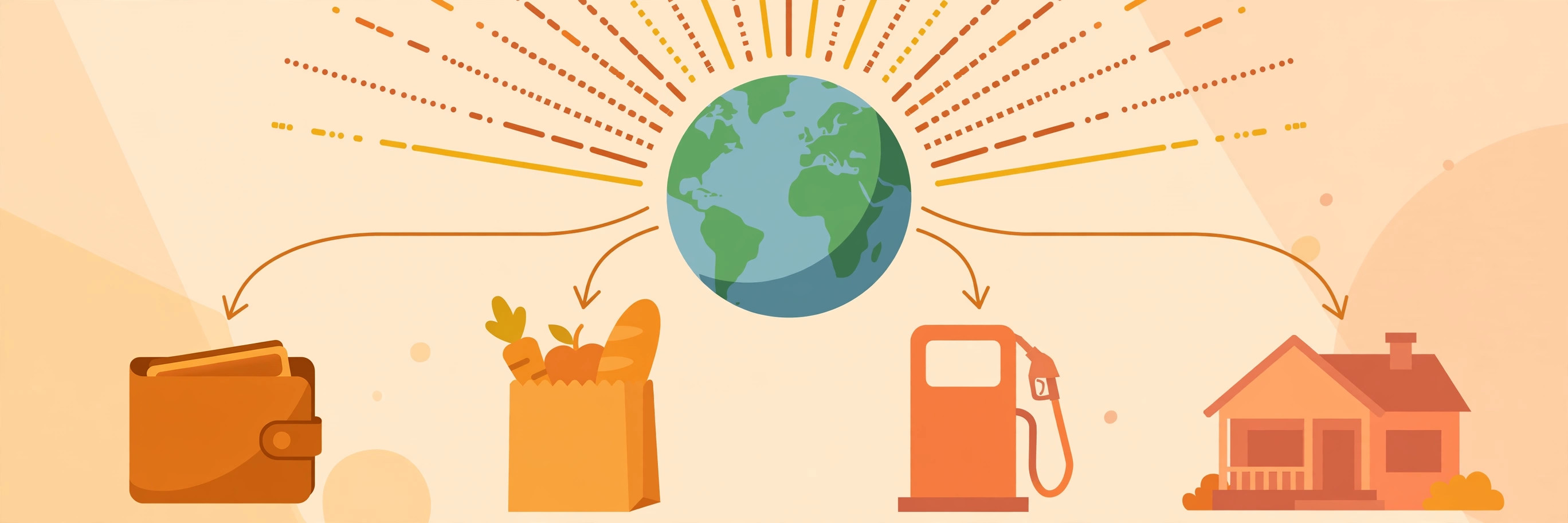
War in the Middle East. New tariffs. The Fed raising rates. The dollar climbing. The headlines pile up, and every one of them sounds expensive — but which ones actually reach your wallet, and how? Most world news affects your money through just five channels: oil, tariffs, the dollar, supply chains, and interest rates. Learn the five, and you can read any scary headline and know within a minute whether it touches your life.
This guide maps each channel in plain English, using what is actually happening in late September 2026 — record diesel prices, a new tariff regime, a Fed rate hike — so you can see the machinery working in real time. No economics degree required.
Channel 1: Oil — from a strait in the Middle East to your gas tank
This is the fastest channel. When the U.S.-Iran conflict that began in late February 2026 disrupted shipping through the Strait of Hormuz, world oil prices surged — Brent crude is around $106–107 a barrel in late September, per Reuters — and the pain arrived at American pumps within weeks.
The numbers: regular gasoline averages about $4.47 a gallon nationally (AAA), the highest ever for this time of year. Diesel hit an all-time record near $6.50 a gallon. But oil does not stop at your gas tank — diesel powers the trucks, trains, and ships that move nearly everything you buy. When diesel jumps 75% in a year, freight surcharges rise, and those costs eventually filter into food prices and store shelves. Energy is the tax hidden inside every product.
How to read it: any headline about Middle East conflict, OPEC decisions, or shipping disruptions is really a headline about your future gas and grocery bills — with a two-to-three-week delay. For the full story, see how global events affect gas prices.
Channel 2: Tariffs — a tax you pay at the checkout
A tariff is a tax on imported goods — but the foreign country does not pay it. The U.S. importer pays it, and then passes some or all of it to you through higher prices. That is the single most misunderstood fact in trade news.
In 2026 the tariff regime expanded sharply: new levies on agricultural imports from Mexico, Canada, and Southeast Asia; a 25% surcharge on Mexican produce like tomatoes, avocados, and berries; and 50% tariffs on Canadian imports. The most exposed grocery categories — coffee, seafood, olive oil, tropical fruit — are already showing price pressure, and analysts warn the full pass-through has a 12-to-18-month lag, meaning tariffs announced in spring 2026 will be felt most in late 2026.
Retailers spent months absorbing the costs — cutting promotions, shifting suppliers — but industry groups warned in 2026 that stores have exhausted their ability to absorb more. When the buffer runs out, the shelf price moves.
How to read it: a tariff headline is a delayed price-increase headline. Ask: what does the U.S. import from that country that I buy? The more specific the product, the more certain the price effect.
Channel 3: The dollar — the quiet discount (or surcharge) on everything foreign
The dollar is near a two-month high — the dollar index (DXY) around 101.2 in late September 2026. A strong dollar makes imports cheaper in dollar terms, which softens price increases on imported goods: electronics, clothing, coffee, cars built abroad.
But it is only a partial offset. Right now the strong dollar is fighting against tariffs and energy costs that push the other way — which is why grocery prices are still up 2.2% from a year ago despite the currency help. Think of the dollar as a discount coupon: welcome, but it does not cancel the whole bill.
It also cuts the other way for the broader economy: a strong dollar makes U.S. exports pricier abroad, squeezing American manufacturers and farmers who sell overseas — which can feed back into jobs in export-heavy regions.
How to read it: dollar headlines matter most if you travel abroad (strong dollar = cheaper trips) or buy lots of imported goods. For the full explainer, see the U.S. dollar, explained.
Channel 4: Supply chains — why shelves go empty before prices move
Sometimes world events do not raise prices first — they remove choices. A conflict, a port closure, or a trade dispute can cut off a specific supply, and the shelf goes bare before the price tag changes.
The pattern: disruption hits raw materials and components first, then factories, then distributors, then your store. By the time a higher cost shows up in the official inflation numbers, it has already traveled through farms, processors, warehouses, and trucking networks. Food industry analysts warned in September 2026 that several cost spikes are currently moving through that pipeline — invisible to shoppers now, visible in a few months.
How to read it: headlines about port strikes, shipping lanes, or export bans are really headlines about availability first and prices second. If a product comes mostly from one region in turmoil, expect gaps on the shelf before you see the higher price.
Channel 5: Interest rates — the Fed's lever on your loans and savings
On September 16, 2026, the Federal Reserve raised its benchmark rate to 3.75%–4.00% — its first increase in over three years — and signaled more could come. This channel is the most personal of the five, because it touches your debt and your savings directly:
- Credit cards and variable-rate loans get more expensive within a billing cycle or two.
- New mortgages and auto loans cost more — the 10-year Treasury yield is at its highest since 2007 (about 5.27%), which sets the tone for 30-year mortgage rates.
- Savings accounts and CDs finally pay meaningful interest again — worth shopping around for if yours has not moved.
Why did the Fed hike while families are squeezed? Because inflation is still running hot — 3.4% over the past year, well above the Fed's 2% target — driven by the same oil shock and tariffs described above. The Fed is trying to cool prices by making borrowing more expensive, which is painful medicine by design.
How to read it: any Fed headline is a headline about your borrowing costs (up) and your savings rate (up). Fixed-rate loans you already have do not change.
How to read a scary headline in 60 seconds
Next time a dramatic world-news alert hits your phone, run this checklist:
- Which channel? Oil, tariffs, dollar, supply chain, or interest rates? Most headlines fit one.
- Is there a lag? Oil takes weeks to reach the pump; tariffs take months to reach shelves. Do not panic-buy on day one.
- Who actually pays? Tariffs are paid by importers (then you). Oil shocks are paid by drivers (then everyone). Rate hikes are paid by borrowers (then savers benefit).
- Is it priced in already? Markets move on expectations. If oil has been high for a month, your gas price already reflects it — the headline is old news for your wallet.
- What is the offset? A strong dollar softens import prices; falling oil softens everything. Rarely does one force act alone.
The bottom line
World news is not just something that happens to other people. Five channels — oil, tariffs, the dollar, supply chains, and interest rates — carry global events straight to your gas tank, your grocery cart, your travel plans, and your loan statements. In late 2026, all five are active at once: a Middle East conflict lifting oil, new tariffs working through supply chains, a strong dollar leaning the other way, and a Fed hiking rates to cool it all down.
You cannot control any of it. But you can understand it — and understanding it is what turns anxiety into a plan: fill up before the lag catches up, expect tariff-hit categories to creep up over months, make sure your savings rate kept pace with the Fed, and check Markets Today for the daily numbers behind the headlines.
Frequently asked questions
Do tariffs really raise prices for American shoppers?
Yes — that is how they are designed to work. The U.S. importer pays the tariff at the border and typically passes much of it to consumers through higher prices. Economic research consistently finds the cost lands on domestic buyers, not the foreign country. The effect is delayed, though: it can take 12–18 months for tariffs to fully show up on store shelves.
Why are groceries still expensive if inflation is cooling?
Because different prices move at different speeds. Grocery inflation slowed to 2.2% over the past year as of August 2026, but energy costs (up 16%+ on the year) are still working through transportation and production costs, and tariff pass-through is still arriving. The shelf is the last stop in a long chain.
Which world events should I actually pay attention to?
The ones that touch a channel: Middle East conflict and OPEC moves (oil), new tariff announcements (store shelves, with a lag), Fed decisions (your loans and savings), and big currency moves (travel and imports). Everything else is interesting but unlikely to change your bills.
Is there anything I can do to protect my budget?
The boring stuff works: keep a little buffer in savings now that rates pay something, avoid new variable-rate debt while the Fed is hiking, buy tariff-exposed staples before the lag catches up, and drive efficiently while gas is at record highs. This is general education, not financial advice.