World
How Global Events Affect Gas Prices in the US, Explained Simply
Why US gas prices move with world events: crude oil markets, the 2026 Iran conflict, taxes, and refineries — plus what drivers can actually do.
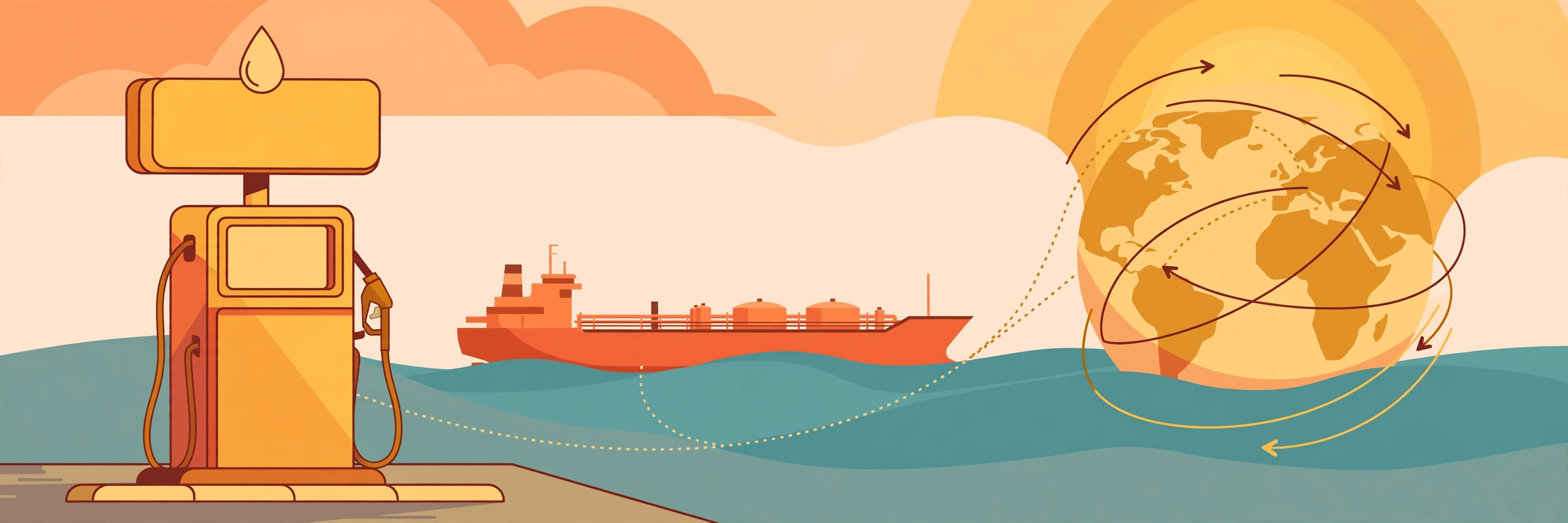
When the price on the gas station sign jumps overnight, it almost never happened because of anything in your town. The price you pay is set mostly by a world market for crude oil — traded in London, shipped through a strait in the Middle East, and moved by wars and decisions made thousands of miles away. Crude oil is roughly half the price of every gallon you buy, so when the world gets nervous, your wallet feels it within weeks.
As of late September 2026, the national average for regular gasoline is about $4.47 a gallon — the highest ever recorded for this time of year, according to AAA. A year ago it was about $3.13. Diesel just hit an all-time record near $6.50 a gallon. This guide explains, in plain English, where that money goes, why world events move it, and what you can actually do about it.
Your gallon has four ingredients
Every gallon of gasoline you buy is made of four costs stacked on top of each other. The U.S. Energy Information Administration (EIA) tracks the mix, and in January 2026 it looked like this:
| Ingredient | Share of the pump price | What it is |
|---|---|---|
| Crude oil | ~51% | The raw oil itself, priced on world markets |
| Refining | ~20% | Turning crude into gasoline at refineries |
| Distribution & marketing | ~11% | Trucking, pipelines, and the station's margin |
| Taxes | ~18% | Federal + state taxes and fees |
The mix shifts with conditions: when crude spikes, oil can be more than 60% of the price; when crude is cheap, taxes and logistics take up a bigger share. But the headline is simple — more than half of what you pay is the world price of oil.
Crude oil is a world market, not an American one
Oil is traded globally, which means a disruption anywhere can raise prices everywhere. The two benchmark prices you will hear about:
- Brent crude — the world benchmark, priced in London. Around $106–107 a barrel in late September 2026, per Reuters.
- WTI (West Texas Intermediate) — the U.S. benchmark. Around $94 a barrel in late September 2026.
The gap between them tells a story: Brent carries the risk premium for Middle East shipping trouble, while WTI reflects mostly U.S. conditions. When the world gets scared, Brent jumps harder.
One choke point matters more than any other: the Strait of Hormuz, the narrow waterway between Iran and Oman. A huge share of the world's seaborne oil passes through it. Anything that threatens that strait — war, blockades, attacks on tankers — sends oil prices up fast, because traders price in the risk of supply being cut off.
What shook the market in 2026
In late February 2026, the United States and Israel began military action against Iran. The conflict has disrupted shipping through the Strait of Hormuz and drawn attacks on Middle East oil infrastructure, including strikes on Saudi facilities by Houthi forces. That is a classic supply shock: millions of barrels a day taken off the global market, or at risk of being taken off.
The numbers tell the story at the pump. AAA reported the national average climbing nearly 5 cents in a single week in late September, with September 2026 on track to be the most expensive September for gasoline on record — the month's average so far is about $4.33 a gallon, beating the old September record of $3.83 set in 2023. Diesel hit an all-time high of about $6.50 a gallon on September 21, up from $3.68 a year earlier.
Oil markets have swung wildly on every headline: hopes of ceasefire talks push prices down a few dollars; a rejected proposal or a fresh attack pushes them right back up. Brent has traded anywhere from the mid-$80s to above $106 in September alone.
Why the pump lags the headlines by weeks
Here is something most people do not realize: gas stations do not reprice the instant oil moves. The crude bought today was purchased weeks ago, refined, shipped, and stored. Economists estimate a two-to-three-week lag between a sustained change in crude prices and the price on the sign.
That lag cuts both ways. When oil spikes on scary news, you get a grace period before the pain arrives — and when oil falls, relief takes just as long to show up. It also means a single day's oil price means almost nothing for your next fill-up; what matters is where oil stays for weeks.
The local stuff: taxes, refineries, and seasons
World oil is the biggest lever, but three local factors explain why your price differs from the national average:
Taxes vary enormously by state. The federal gas tax is 18.4 cents a gallon everywhere, but states add their own. California's taxes and fees total about 73.6 cents a gallon — a big reason regular gas there averaged about $6.35 a gallon in late September 2026, the highest in the nation. Texas, with far lower taxes, averaged about $3.95. Same oil, very different pump.
Refineries have maintenance seasons. Refineries shut down units for maintenance in spring and fall, which can tighten regional supply. When a big refinery has an unplanned outage — a fire, a hurricane shutdown — prices in that region can jump even if world oil is calm.
Gasoline itself changes with the seasons. Summer-blend gasoline, required in many areas to reduce smog, costs more to make. That is one reason prices usually rise in spring and fall in autumn — though in 2026, the usual autumn drop never came, because the oil shock overwhelmed the seasonal pattern.
What you can actually do about it
You cannot move the world oil market. But you can shrink how much of it you buy:
- Drive gentler. Aggressive acceleration and speeding can cut fuel economy by 15–30% on the highway, per the U.S. Department of Energy. Slowing down is free money.
- Keep tires inflated and the car maintained. Under-inflated tires alone waste a few percent of your fuel. A clogged air filter and old spark plugs make it worse.
- Cut the idle and the dead weight. Idling burns fuel for zero miles. A roof cargo box or a trunk full of stuff you do not need drags economy down.
- Plan and combine trips. A cold engine uses more fuel, so several short trips cost more than one combined run.
- Compare stations, not brands. Prices within a few miles can differ by 20–40 cents a gallon. Free gas-price apps make the comparison take seconds.
- If you are car shopping, do the math on efficiency. At $4.50 a gallon, the gap between a 25-mpg car and a 35-mpg car is about $770 a year for 12,000 miles of driving. That is real money — and worth more than most people guess.
For a broader look at how oil, the dollar, and trade all reach your budget, see how world events hit your wallet, and check our Markets section for the daily price picture.
Frequently asked questions
Why did gas go up when nothing changed in my state?
Because your state's supply is a tiny slice of a world market. About half your gallon's price is crude oil, and crude is priced globally. A threat to shipping in the Strait of Hormuz raises the price of oil everywhere — including the oil refined into the gas sold in your town.
Do gas stations gouge when oil spikes?
Most stations make only a few cents a gallon in margin; the big money in a spike goes to oil producers and refiners, not the corner station. That said, prices famously rise faster than they fall — stations reprice quickly when their replacement fuel will cost more, and slowly when it will cost less.
Why is diesel so much more expensive than gasoline right now?
Diesel and gasoline are different products from the refinery, and diesel is more exposed to global disruptions — Europe and much of the world run on diesel, so world demand hits it harder. In September 2026 diesel hit an all-time record near $6.50 a gallon, up roughly 75% from a year earlier, while gasoline rose about 40%.
Will prices come back down?
Gas prices always cycle — but nobody can promise when. Prices fall when supply recovers, demand softens, or geopolitical fear fades; the two-to-three-week lag means you will see it at the pump after it happens in the oil market, not before. Watch sustained crude trends, not single-day headlines. For the daily picture, see Markets Today.