Guides
AI and Crypto Mining: How Machine Learning Is Changing Mining
How AI is used in crypto mining — predictive maintenance, energy savings, the 2026 pivot to AI data centers — plus AI mining scam warnings.
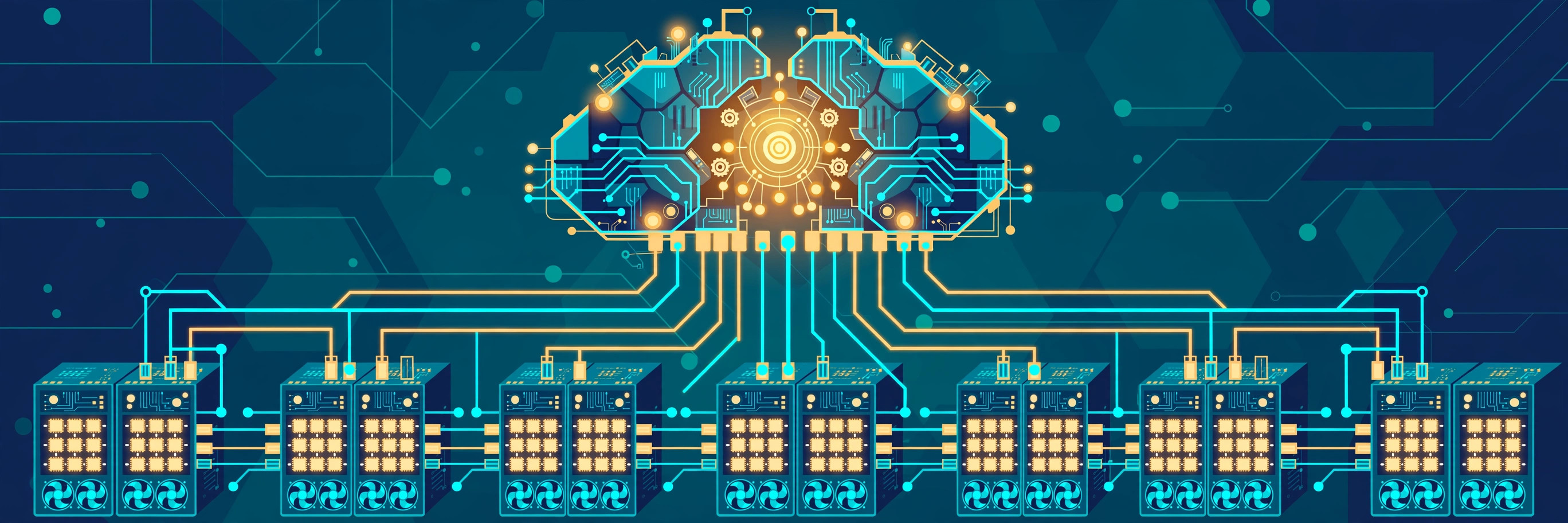
Can artificial intelligence help with crypto mining? The short answer is yes — but probably not the way you've seen it advertised. AI can't make a mining machine guess winning hashes any faster. Mining is deliberately random, like a lottery that resets every ten minutes, and no algorithm can outsmart randomness. Where machine learning genuinely helps is in everything around the mining: keeping thousands of machines healthy, catching failing hardware early, and trimming the industry's biggest cost — the electricity bill.
That distinction matters, because "AI mining" has become one of the hottest buzzwords in crypto scams promising effortless passive income. Meanwhile, the biggest real AI-and-mining story of 2026 is different: Bitcoin miners converting their facilities into AI data centers. Per CoinShares' Q1 2026 report, miners have announced over $70 billion in cumulative AI and high-performance computing contracts — renting power to AI companies can generate far more revenue per megawatt than mining Bitcoin (ainvest).
This guide explains where machine learning genuinely helps miners, where the hard limits are, and how to spot the scams cashing in on the hype. It's education only — not financial advice, and not a recommendation to mine anything.
Where AI genuinely helps miners
Modern mining is industrial work. Large operations run tens of thousands of specialized machines called ASICs (application-specific integrated circuits — chips built to do one thing: mine). At that scale, the hard part isn't the mining itself — it's managing the fleet. That's the kind of problem machine learning handles well: watching sensor data and spotting patterns humans would miss.
- Fleet monitoring and tuning. AI systems track each machine's hashrate, temperature, and power draw, then adjust settings like clock speeds and voltages to squeeze out more efficiency. Technical assessments rate adaptive power-scaling and thermal management among the most promising real uses (ingoampt).
- Anomaly detection. Models learn what "normal" looks like for a machine and flag the ones behaving oddly, so technicians can check them before they fail.
- Scheduling around electricity prices. Where power prices change by the hour, software decides when to run flat-out, throttle back, or pause — matching compute to the cheapest power windows.
These are real, unglamorous improvements. Shaving a few percent off power costs across 50,000 machines adds up to serious money.
Predictive maintenance: fixing rigs before they break
A dead miner earns nothing while it waits for repairs. Predictive maintenance uses machine learning to estimate which machines are likely to fail next, so technicians can service them during planned downtime instead of discovering failures after hours of lost output.
The approach is the same one used in factories and airlines: train a model on historical sensor readings — temperatures, vibration, fan speeds, error counts — and it learns the warning signs that precede a breakdown. Technical reviews rate predictive maintenance as one of the most practical AI applications in mining today.
One honest caveat: the AI has to justify its own costs. A 2026 analysis notes that adding an expensive GPU-powered control system to optimize a small home setup is usually self-defeating — the AI's extra electricity can exceed whatever it saves. For a hobbyist, a monitoring dashboard and sensible cooling beat any "AI optimizer" app (ingoampt).
Energy efficiency and smart power use
Electricity is the biggest cost in mining — operators have traditionally needed power under about $0.03 per kilowatt-hour to stay competitive. AI helps on several fronts:
- Smarter cooling. Adaptive fan control and airflow management, guided by models that predict heat buildup, cut cooling energy while keeping chips within safe temperatures.
- Power-price arbitrage. Some miners get paid to switch off. In Texas, Riot Platforms earned $21.0 million in power reduction credits in Q1 2026 — $13.5 million for reducing usage plus $7.5 million from demand response programs — pushing its net electricity cost down to about $0.03 per kWh (Cozzy Energy Solutions). Software that automatically responds to grid price signals turns power flexibility into a second revenue stream.
For scale: Cambridge estimates Bitcoin's total power use at roughly 138 terawatt-hours per year — about half a percent of global electricity — with about 52% now from renewable and nuclear sources (Blofin/Cambridge). AI data centers already consume roughly three times that, and are growing far faster.
The big story of 2026: miners are becoming AI data centers
The most significant way AI is "changing" mining in 2026 isn't optimization — it's replacement. Miners own exactly what the AI boom needs: land with massive, already-approved grid connections and experience running industrial-scale computing around the clock. AI companies pay premium rates for it.
According to CoinShares' Q1 2026 report, miners had announced over $70 billion in cumulative AI and high-performance computing contracts, with AI revenue projected to reach roughly 70% of combined revenue by the end of 2026. AI workloads can generate 3 to 25 times more revenue per megawatt than Bitcoin mining, with long-term contracts offering margins of 80–90% (ainvest).
Recent examples: TeraWulf locked in over $12.8 billion in contracted computing revenue (news.bitcoin.com); Core Scientific signed a $10.2 billion, 12-year deal with CoreWeave; Hut 8 announced a $7 billion Google-backed deal (techi.com); IREN halved its installed mining capacity to pivot toward AI cloud services (cryptotimes.io); and Hyperscale Data switched off all its Bitcoin miners on September 1, 2026, redirecting power to an AI compute agreement worth over $1.2 billion (stocktitan.net).
The pivot even shows in Bitcoin's network stats: hashrate spent months below its late-2025 peak as miners redirect power to AI contracts. None of this threatens Bitcoin's security — difficulty adjusts to protect remaining miners — but it confirms AI's biggest impact on mining is as a competitor for power, not a helper.
What AI can't do: the hard limits
AI can't beat the difficulty adjustment. Bitcoin adjusts mining difficulty roughly every two weeks so new blocks appear about every ten minutes, regardless of total computing power. If every miner doubled efficiency overnight, difficulty would double too. Nobody mines more Bitcoin because of AI. (Our plain-English Bitcoin explainer covers how this works.)
AI can't "predict" winning hashes. Finding a valid block is random — each guess is independent, like another lottery ticket. A 2026 technical review rated neural-network hash prediction as unsupported: there is no pattern to find. Claims that an "AI algorithm" mines smarter are nonsense.
AI can't fix the economics. Profitability comes down to the coin's price, the block reward, network difficulty, your electricity cost, and your hardware cost. AI shaves the edges, but it can't make an unprofitable operation profitable. If your power is too expensive, no algorithm saves you.
AI can't predict crypto prices. Some platforms bundle "AI price forecasts" into their mining pitch. It doesn't make mining a sure thing — and AI price prediction is far less reliable than sellers claim, as we explain in Can AI Predict Crypto Prices? The Honest Answer. Even a perfect forecast wouldn't change your electricity bill.
Watch out: "AI mining" passive-income scams
Scammers have run fake "cloud mining" schemes for years; AI hype gave them a fresh coat of paint. The modern version: an app or website promising daily passive income from "AI-powered mining" — no hardware, no knowledge, just deposit crypto, often via Telegram bots or slick mobile apps.
The red flags are consistent (newscoverage.agency, coinvalue.us):
- Guaranteed or fixed daily returns ("earn 2% every day!"). Real mining returns fluctuate with prices, difficulty, and energy costs — fixed-profit promises are lies.
- No verifiable hardware. They claim "AI-optimized data centers" but can't show a facility, a mining pool address, or proof of actual mining.
- Referral-heavy payouts. If you earn more from recruiting friends than from "mining," it's a pyramid scheme. Collapses like MiningMax (2017) and BitPetite — 2% daily returns before vanishing with $4.7 million — followed this playbook (iplaycrypto.com).
- Anonymous teams and "unlock" fees. No verifiable founders, plus demands that you pay a fee to withdraw your own money — a classic tell. Legitimate platforms never do this.
- Pressure and FOMO. "Limited spots!" "Join before the AI allocation fills!" Scarcity theater is designed to stop you thinking.
The rule of thumb: if a platform's "AI" is supposedly why it earns returns nobody else can match, and you can't independently verify the mining exists, walk away. Real mining is a thin-margin industrial business — there is no version of it that pays strangers 2% a day. Read What Is Crypto Mining? How It Actually Works, Explained Simply before judging any pitch, and AI and Crypto: What AI Can (and Can't) Do for Crypto Beginners for the broader landscape.
Frequently asked questions
Can AI make my mining rig more profitable?
Marginally. AI can help monitor machines, catch failures early, and tune cooling and power settings — but it can't change Bitcoin's price, network difficulty, or your electricity rate. For a home miner, cheap power and sensible cooling matter far more than any AI tool.
Is "AI cloud mining" legit?
Almost never. Real cloud mining exists, but margins are thin and its history is littered with scams. When "AI" joins the pitch alongside guaranteed returns, referral bonuses, and anonymous operators, you're almost certainly looking at a Ponzi scheme.
Why are Bitcoin miners switching to AI data centers?
Better, steadier money: 3 to 25 times more revenue per megawatt than mining, backed by multi-year contracts with 80–90% margins. Miners already own the hard part (grid connections, land, cooling expertise). Our guide on using AI for stock market research shows how to look into any business carefully — without getting burned.
Can AI tell me which coin is most profitable to mine?
Profitability calculators compare coins using current difficulty, block rewards, and prices — but that's arithmetic, not intelligence, and the numbers shift constantly. Any tool claiming its AI "knows" next month's winner is selling certainty it doesn't have. Same skepticism applies to trading: see AI Trading Bots Explained: Do They Actually Work?
The bottom line
AI's real role in mining is boring in the best way: it helps big operations run machines a little more efficiently, catch breakdowns earlier, and use electricity more cleverly. On a bigger scale, AI is reshaping the industry from the outside — miners are discovering their power connections are worth more to AI companies than to Bitcoin.
What AI is not is a shortcut to free money. It can't outsmart mining's randomness, override the difficulty adjustment, or fix bad economics. Anyone selling "AI mining" as effortless passive income is selling the oldest trick in the crypto book with a new buzzword.
Educational content only — not financial advice. Nothing here is a recommendation to mine, invest in, or buy any cryptocurrency or mining service. If a deal sounds too good to be true, it is.