Guides
Bitcoin and Blockchain Explained Simply for Beginners
Bitcoin and blockchain explained in plain English: how the system works, wallets and keys, scams to avoid, and using an AI chatbot as a tutor.
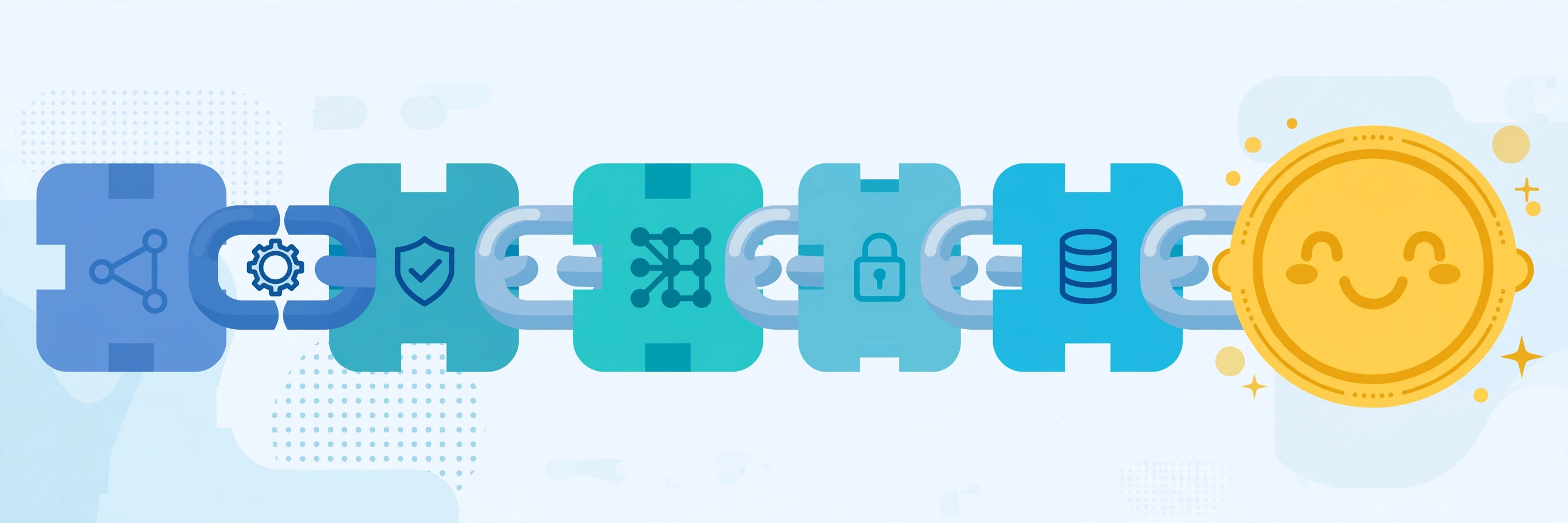
Bitcoin is digital money that works without a bank. That's really the whole idea. You can send it to anyone in the world directly — no bank, no company, no middleman. It was invented in 2009 by a mysterious creator (or creators) known as Satoshi Nakamoto, and nobody — not a company, not a government — runs it.
One detail clears up half the confusion: the word Bitcoin means two things. Capital-B Bitcoin is the network, the system that keeps track of everything. Lowercase bitcoin (BTC) is the money itself. A blockchain is the shared record book the network uses — a ledger that thousands of computers around the world each hold a copy of, and constantly check against each other. That's how it stays trustworthy without a boss.
This guide explains it all slowly, in plain English, with zero hype. It's education only — nothing here is financial advice.
What Bitcoin actually is
Strip away the headlines and Bitcoin is a payment network plus a currency. The network is software running on tens of thousands of independent computers. The currency, BTC, is what moves across it. The rules are baked into the software itself — there's no CEO to call.
- There will only ever be 21 million bitcoins. The limit is written into the code — nobody can print more. By 2026, roughly 95% of the supply had already been created; the rest will be released gradually until about 2140.
- You don't need a whole coin. Each bitcoin splits into 100 million pieces called satoshis (named after the creator). With bitcoin in the mid-$80,000s in late September 2026, even a tiny fraction is a meaningful amount — you can own a sliver, not a whole coin.
- Regular investment funds can hold it now. Since January 2024, US spot bitcoin ETFs have let ordinary investors get bitcoin exposure through a normal brokerage account. It's been bumpy: 2026 flows flipped to about $800 million net in late September after a rough summer of withdrawals, per CoinDesk's market coverage.
One honest caveat: bitcoin's price swings wildly — thousands of dollars in a single day is normal. That volatility is exactly why this article is education-only.
What a blockchain is: the simplest analogy
Imagine a notebook in the middle of a crowded room where everyone has their own identical copy. When money moves, everyone writes down the same entry on the same page. Once a page is full, it's glued shut and sealed — that's a block. Each page also carries a stamp proving it connects to the previous page, so the pages form a chain. Blockchain: a chain of sealed record pages.
Why is this clever? If someone tried to cheat by erasing a line on page 14, their copy would no longer match the thousands of others — and the broken seal would expose it. The seal is a piece of math called a hash, a fingerprint for the page's contents: change one letter and the fingerprint completely changes. The network spots the mismatch and ignores the tampered copy. Records aren't locked in a vault; they're protected by math and by everyone watching. That's why blockchains are called hard to alter.
How a Bitcoin transaction actually works
Four steps, no jargon left unexplained:
- You ask to send. In your wallet app, you enter the recipient's address — a long string of letters and numbers that works like an account number — and the amount. Your app signs the transaction with your secret key, proving the coins are yours to spend. No bank approval needed.
- The network checks your homework. The transaction is broadcast to thousands of computers, which verify your signature and confirm the coins haven't already been spent elsewhere. This prevents double-spending — using the same digital money twice.
- Miners bundle it into a block. Valid transactions are gathered into the next block, sealed and added to the chain roughly every 10 minutes. The computers doing this work — miners — earn a reward, currently 3.125 BTC per block since the April 2024 halving, set to halve again around 2028. (See What Is Crypto Mining? How It Actually Works, Explained Simply, and AI and Crypto Mining: How Machine Learning Is Changing Mining for how miners use AI to stay competitive.)
- The money arrives. Once your transaction sits inside a sealed block, the recipient can see it. Each block added afterward is a confirmation, making it progressively harder to reverse. A few confirmations — roughly 10 minutes to an hour — is considered settled.
Notice what's missing: no bank, no clerk, no closing hours. The network runs around the clock in every country at the same speed.
Wallets and keys, in plain English
A wallet doesn't hold your bitcoin — your coins live on the blockchain itself. A wallet is better thought of as a keychain app: it stores the keys that let you spend, and shows your balance by reading the public record.
Two kinds of keys to know:
- Your public address is like an email address or PO box — share it freely so people can send you bitcoin. Sharing it lets no one spend your money.
- Your private key is the secret proving ownership — the actual key to the lockbox. Anyone who has it controls your coins. Never share it. Ever.
Most wallets also give you a seed phrase — 12 or 24 ordinary words (like apple river clock mountain) that acts as a master backup. Typed into any wallet app, it rebuilds your keys and restores your money. Anyone who sees those words can take everything, so write them on paper, keep the paper somewhere safe, and never photograph, email, or store them digitally.
You'll also hear hot vs cold wallets. A hot wallet is an app on your phone — convenient and internet-connected, like cash in your pocket. A cold wallet is a physical device (or paper record) kept offline — like a safe deposit box. Beginners usually start with a hot wallet from a reputable maker; cold storage only matters for meaningful amounts held long-term.
One rule to tattoo on your brain: there is no "forgot password" button. Lose your keys and seed phrase, and the coins are gone permanently. Nobody — not the wallet company, not a bank — can recover them.
Common beginner mistakes and scams (please read this part)
Crypto transactions can't be reversed, which makes scams final. Almost every crypto scam is a twist on one idea — tricking you into handing over your keys, your seed phrase, or your money. The classics:
- "Send me bitcoin and I'll double it." Fake celebrity giveaways promise to multiply whatever you send. They never send anything back — the logos and photos are stolen or faked.
- Seed-phrase theft. No legitimate support person, exchange, or wallet company will EVER ask for your private key or seed phrase. If someone does, it's a scam — full stop.
- Fake wallets and phishing. Copycat apps and lookalike websites steal your keys when you type them in. Only download wallet software from the official source.
- Address-swapping malware. Malicious software can replace a recipient's address when you paste it. Always double-check the first and last few characters before sending.
- "Guaranteed returns" schemes. Anything promising fixed, risk-free profits is fraud by definition — including many trading bots sold with slick marketing. Our guide AI Trading Bots Explained: Do They Actually Work? explains why even legitimate bots can't promise profits.
Your simplest protection: slow down, keep your keys offline, and assume any stranger offering free money is lying. Scams rely on urgency and pressure.
Using an AI chatbot as your tutor
The real secret to learning Bitcoin is asking questions constantly — and a chatbot like ChatGPT, Claude, or Gemini makes a patient, free tutor. Use it well:
- Ask for simpler versions. "Explain the blockchain like I'm ten," or "Use a cooking analogy for mining." A chatbot will re-explain as many times as you need.
- Go one piece at a time. "What exactly does a private key do?" Master one idea, then the next — rather than "explain all of crypto."
- Test yourself. "Quiz me on the halving and correct me where I'm wrong." Getting corrected is the fastest way to learn.
- Never ask for investment advice. A chatbot can't see the future, and its training data has a cutoff — it can be confidently wrong about prices and news. Can AI Predict Crypto Prices? The Honest Answer explains why "what will bitcoin be worth next year?" is a question no AI can answer.
- Never paste your seed phrase or private keys into any chat, ever.
For the bigger picture, see AI and Crypto: What AI Can (and Can't) Do for Crypto Beginners — and if you also research stocks, How to Use AI for Stock Market Research (Without Getting Burned) applies the same cautious principles to the stock market.
FAQ
Is bitcoin real money?
Some businesses accept it and it can be exchanged for traditional currency, but it's not legal tender in most countries and its price swings make everyday spending awkward. Most people treat it more like digital gold than cash in their pocket.
Do I need to buy a whole bitcoin?
No. Because each bitcoin splits into 100 million satoshis, you can own any amount — a tenth, a thousandth, even a few dollars' worth. (That's how the math works, not a recommendation.)
Can the Bitcoin network be hacked?
No attacker has ever rewritten the blockchain or counterfeited bitcoin — the math plus thousands of independent computers checking each other makes that practically impossible. But your wallet can be hacked via phishing, malware, or a stolen seed phrase. The network is secure; the weakest link is usually the human.
Is bitcoin anonymous?
Not really. It's pseudonymous: addresses don't show your name, but every transaction is permanently visible on the public blockchain.
What happens when all 21 million bitcoins are mined?
The new-coin reward shrinks at each halving (next: around 2028, 3.125 down to 1.5625 BTC) until it rounds to zero near 2140. After that, miners earn only transaction fees, and the network keeps running.
Bottom line
Bitcoin is money without a bank; blockchain is the shared, tamper-resistant record that makes it possible. You now know the essentials: the 21 million limit, blocks sealed roughly every 10 minutes, the wallet-key system, and how to spot beginner-targeted scams.
The smartest next step is to keep learning. Open a chatbot and interrogate it about anything that didn't click. Read our mining explainer for the full picture of how new coins enter the world. And remember this article's one rule: understand before you touch — and never put in anything you couldn't afford to lose entirely.